AI - Third-Party Cyber Security Due-Diligence
Artificial Intelligence - Supplier and Vendor Cyber Security Due-Diligence
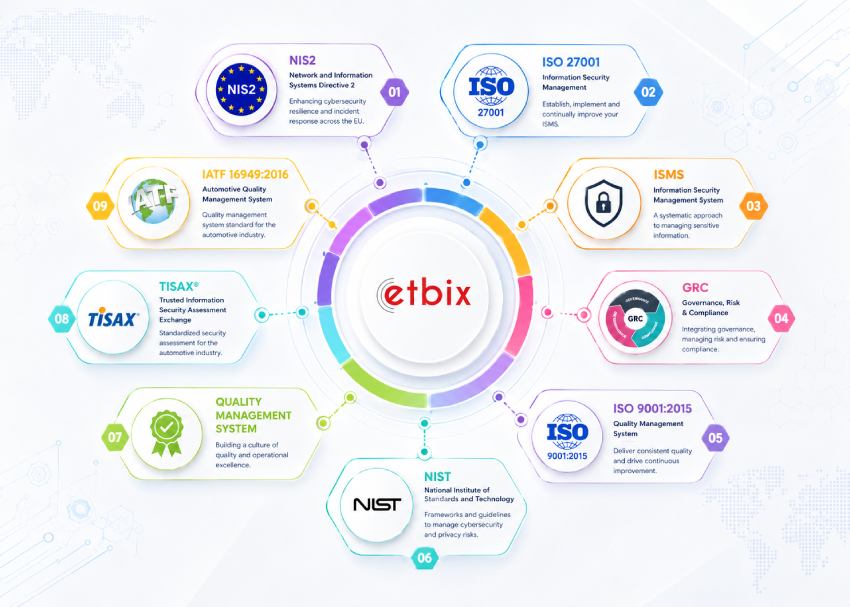
Cetbix supports multi-framework compliance and provides end-to-end traceability across assets, risks, controls, and audit evidence, making it particularly suitable for organizations implementing structured management systems.
Third-Party Cyber Security Due-Diligence (CDD)
Cloud, Services & Information Systems Risk Assessment
Are you looking to implement a structured risk assessment process for new software, cloud providers, or technical implementations across your organization?
Cetbix’s AI-driven Third-Party Services and Solutions Cybersecurity Due Diligence (CDD) platform provides an automated, intelligent approach to evaluating supplier and system security risks—helping you make faster, safer, and more informed decisions.
Automated Risk Assessment
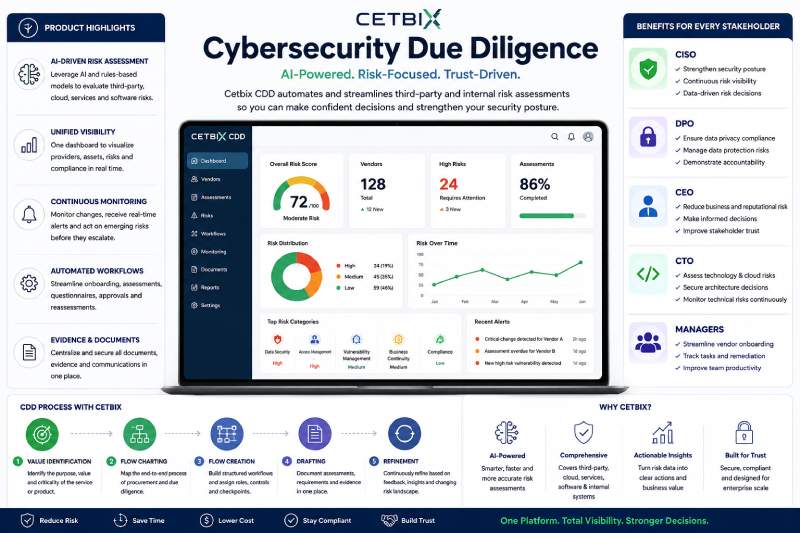
Cetbix CDD delivers a unified, real-time dashboard that enables complete visibility and control over your ecosystem.
-
📊 Unified Risk Dashboard : Visualize all providers, services, and associated risks in one centralized view.
-
🚨 Continuous Monitoring : Track critical changes across systems and receive real-time insights.
-
⚙️ Actionable Intelligence : Take immediate, data-driven actions based on live risk signals.
AI-Powered Cyber Risk Intelligence
The platform continuously evaluates and updates organizational risk profiles using AI-driven analysis, enabling proactive security decision-making across the procurement and operations lifecycle.
-
🔍 Procurement Risk Optimization : Identify and eliminate inefficiencies early in the procurement process.
-
🧠 Complete Data Visibility : Gain a full understanding of the data your organization holds and how it is exposed.
-
🛡️ Proactive Cyber Risk Mitigation : Predict, identify, and reduce cyber threats across your entire ecosystem, including third-party relationships.
Cybersecurity Due diligence
Key Features
🛡️ Centralized Security Intelligence : Consolidate cybersecurity assessments, vendor risks, compliance records, and due diligence data into one unified platform for complete visibility and control.
🔍 Advanced Risk Assessment Capabilities : Conduct comprehensive cybersecurity evaluations using both qualitative insights and quantitative risk scoring to support informed decision-making.
⚙️ Automated Compliance & Due Diligence Workflows : Streamline security reviews, evidence collection, and regulatory alignment with automated workflows and continuous tracking.
🚨 Continuous Threat & Risk Monitoring : Detect emerging cyber risks early with real-time alerts, proactive monitoring, and ongoing security posture assessments.
📊 Customizable Executive Dashboards : Create tailored dashboards to monitor cybersecurity KPIs, third-party risk exposure, compliance status, and due diligence progress in real time.
Why Choose Cetbix CDD?
Traditional risk, governance, and compliance processes are no longer sufficient in today’s fast-moving threat landscape. Cetbix delivers a modern AI/automation platform that reduces manual effort, improves efficiency, and enables scalable cybersecurity due diligence.
Cetbix brings everything into one platform, allowing teams to easily adjust priorities, update timelines, and manage assignees. Built for approvals, it centralizes all feedback, decisions, and comments in one place for faster action. Users can also attach documents, images, and videos directly to comments for clearer, more accurate collaboration.
Operational Modules
🧾 Incident Management : Track and resolve security incidents with full audit trails and real-time visibility.
📁 Assessment & Workflow Management : Manage cybersecurity due diligence, vendor assessments, and remediation in a unified workspace.
📦 Asset & Vendor Inventory : Maintain a structured view of assets and third-party vendors for stronger risk oversight.
📄 Secure Document Management : Store and control access to critical compliance and security documentation.
CDD Visibility & Monitoring
A unified dashboard provides full visibility into vendors and risks, enabling proactive cybersecurity due diligence.
-
Centralize third-party risk and external data in one system
-
Automate vendor onboarding and due diligence workflows
-
Monitor provider performance and trigger reassessments when needed
Automation & Intelligent Risk Control
Automation strengthens security posture by enforcing compliance standards, reducing data exposure, and ensuring consistent policy application across all data volumes. Data is automatically classified into risk categories, with the appropriate controls applied in real time—enabling scalable, adaptive governance as your organization grows.
- 🛡️ Automated Policy Enforcement : Ensure consistent application of security and compliance controls across all data environments.
- 📊 Risk-Based Data Classification : Automatically categorize data into risk tiers for accurate protection and governance.
- ⚙️ Scalable Security Controls : Maintain compliance and security integrity as data volume and complexity increase.
Vendor Management Capabilities
- 👁️ Full Vendor Visibility : Gain complete insight into all vendor relationships in one centralized platform (Check our Vendor Management System).
- 🏷️ Branded Vendor Portal : Create and host a fully customized vendor portal aligned with your organization’s identity (Check our Vendor Management System).
- 🤝 Automated Onboarding : Streamline vendor onboarding and self-registration to reduce manual effort and accelerate engagement (Check our Vendor Management System).
Continuous Improvement & Measurement
- 📈 Performance Metrics & Insights : Transform operational input into actionable metrics that drive continuous improvement.
- 🔄 Continuous Feedback Loops : Capture ongoing feedback to identify emerging risks and trigger timely audits.
- 🚀 Optimized Process Effectiveness : Strengthen governance and compliance through data-driven process refinement.

Cetbix CDD is a structured approach
Cetbix CDD is a structured approach designed to eliminate gaps in third-party due diligence processes. It empowers stakeholders to identify inefficiencies and streamline every stage of service or product procurement—from initial concept through to final implementation—ensuring full visibility and control at each step.
Cetbix focuses on five core elements of the due diligence lifecycle:
-
🎯 Value Identification : Define and assess the business and security value of the proposed service or product.
-
🧭 Process Flow Mapping : Visualize end-to-end procurement and due diligence workflows for clarity and control.
-
🛠️ Workflow Creation : Design structured, automated processes for evaluating third-party risks and requirements.
-
📝 Drafting & Documentation : Capture all assessments, decisions, and compliance requirements in a centralized format.
-
🔄 Refinement & Optimization : Continuously improve processes based on feedback, insights, and evolving risk landscapes.
AI-Powered Cyber Risk Intelligence
The platform continuously evaluates and updates organizational risk profiles using AI-driven analysis, enabling proactive security decision-making across the procurement and operations lifecycle.
- 🔍 Procurement Risk Optimization : Identify and eliminate inefficiencies early in the procurement process.
- 🧠 Complete Data Visibility : Gain a full understanding of the data your organization holds and how it is exposed.
- 🛡️ Proactive Cyber Risk Mitigation : Predict, identify, and reduce cyber threats across your entire ecosystem, including third-party relationships.
Benefits for CISO, DPO, CEO, CTO & Managers
Cetbix CDD AI empowers leadership teams with a unified, intelligent approach to cybersecurity risk evaluation across third-party and internal ecosystems.
By leveraging Cetbix’s AI-driven security risk assessment, organizations can:
-
🔐 Close Third-Party Due Diligence Gaps : Eliminate blind spots across vendor and supplier evaluation processes.
-
🛡️ Strengthen Organizational Security Posture : Enhance overall resilience through continuous risk visibility and control.
-
📊 Improve Cyber Risk Governance : Gain clear cybersecurity risk ratings to better manage and prioritize threats.
-
🔄 Enable Continuous Security Assessment : Monitor internal and external security activity on an ongoing basis.
-
👁️ Increase Stakeholder Visibility : Provide decision-makers with real-time understanding of the current security landscape.
Cetbix combines rules-based logic with dynamic AI-driven analysis, delivering more accurate, contextual, and adaptive risk assessments than traditional static approaches.
FAQs
Vendor Assessment FAQs
1. What is a vendor security assessment?
A vendor security assessment evaluates the cybersecurity posture, compliance maturity, and risk exposure of third-party suppliers, service providers, and business partners. Organizations use vendor assessments to identify potential security weaknesses, verify compliance with internal requirements, and reduce supply chain risk.
Vendor security assessments are an essential component of third-party risk management, helping organizations make informed decisions before onboarding or renewing vendor relationships.
2. How does vendor assessment automation work?
Vendor assessment automation streamlines supplier evaluations through automated questionnaires, workflow management, risk scoring, evidence collection, remediation tracking, and reporting.
Automation reduces manual effort, accelerates assessment cycles, improves consistency, and enables organizations to evaluate more vendors without increasing operational overhead.
3. Can vendors complete assessments online?
Yes. Vendors can securely complete assessments online through a self-service portal. Questionnaires, evidence requests, compliance documentation, and remediation activities can all be managed digitally.
Online assessments improve efficiency, reduce email-based communication, and provide a centralized repository for vendor risk information.
4. How are vendor risks scored?
Vendor risks are typically scored based on assessment responses, security controls, compliance status, criticality, data access levels, and identified vulnerabilities.
Risk scoring models help organizations prioritize suppliers according to their potential impact on business operations, regulatory obligations, and cybersecurity exposure.
5. Does vendor assessment support reassessments?
Yes. Ongoing reassessments ensure vendors continue to meet security and compliance requirements throughout the lifecycle of the relationship.
Periodic reviews help organizations identify changes in risk posture, validate remediation efforts, and maintain continuous third-party oversight.
6. How does vendor assessment improve supplier risk management?
Vendor assessment improves supplier risk management by providing visibility into cybersecurity controls, compliance maturity, operational resilience, and risk exposure across the supply chain.
Organizations gain a structured process for identifying, evaluating, monitoring, and mitigating third-party risks.
7. Can remediation activities be tracked?
Yes. Remediation tracking enables organizations to monitor corrective actions, assign responsibilities, establish deadlines, and verify closure of identified risks.
This ensures assessment findings are addressed and vendors remain aligned with security requirements.
8. How does vendor assessment support NIS2 compliance?
NIS2 places significant emphasis on supply chain security and third-party risk management. Vendor assessments help organizations evaluate supplier cybersecurity controls, identify risks, and demonstrate compliance with NIS2 obligations.
Assessment workflows can be aligned with NIS2 requirements to support regulatory readiness.
9. Does vendor assessment support DORA third-party assessments?
Yes. DORA requires financial entities to manage ICT third-party risks and maintain oversight of critical service providers.
Vendor assessments help organizations evaluate supplier resilience, cybersecurity controls, contractual obligations, and operational risks in accordance with DORA requirements.
10. Can vendor assessments be customized?
Yes. Assessment frameworks, questionnaires, risk scoring models, evidence requirements, workflows, and reporting can all be customized to meet organizational requirements.
Customization ensures assessments align with industry regulations, business objectives, and risk management strategies.
11. What vendor assessment templates are available?
Organizations commonly use templates aligned with ISO 27001, NIST CSF, SOC 2, TISAX, GDPR, NIS2, DORA, CIS Controls, IEC 62443, and industry-specific standards.
Pre-built templates accelerate deployment and improve assessment consistency.
12. How does vendor assessment support onboarding?
Vendor assessments can be integrated into onboarding processes to ensure security reviews are completed before suppliers gain access to systems, data, or critical business processes.
This helps organizations identify risks early and establish clear compliance expectations.
13. What integration capabilities are available?
Vendor assessment platforms often integrate with GRC systems, procurement platforms, ERP solutions, ticketing systems, document repositories, identity management solutions, and security monitoring tools.
Integration improves efficiency and reduces duplicate data entry.
14. How is vendor risk visibility improved?
Centralized dashboards, reporting tools, risk heat maps, supplier scorecards, and executive summaries provide clear visibility into vendor risk exposure across the organization.
Stakeholders can quickly identify high-risk suppliers and emerging issues.
15. Can high-risk vendors be prioritized?
Yes. Risk-based prioritization enables organizations to focus assessment efforts on vendors with the highest potential business impact, regulatory exposure, or cybersecurity risk.
This helps allocate resources efficiently and improve risk management outcomes.
16. How does vendor assessment support contract management?
Assessment results can be linked to contractual obligations, security requirements, service level agreements, and compliance commitments.
This enables organizations to verify vendors continue meeting agreed-upon security and compliance standards.
17. What reporting capabilities are available?
Reporting capabilities typically include executive dashboards, vendor scorecards, risk assessments, compliance reports, remediation tracking reports, supplier performance metrics, and board-level summaries.
Reports support informed decision-making and stakeholder communication.
18. How is assessment consistency maintained?
Consistency is achieved through standardized questionnaires, predefined assessment methodologies, automated workflows, scoring models, and repeatable review processes.
Standardization improves assessment quality and comparability across vendors.
19. Can vendor portfolios be managed centrally?
Yes. Vendor portfolio management provides a consolidated view of supplier relationships, assessment status, risk levels, compliance posture, remediation activities, and criticality rankings.
Organizations gain visibility across their entire third-party ecosystem.
20. How does continuous vendor monitoring work?
Continuous monitoring combines periodic reassessments, automated alerts, risk updates, evidence reviews, and ongoing compliance checks.
This approach enables organizations to identify changes in vendor risk posture throughout the relationship lifecycle.
21. What security questionnaires are commonly used?
Common questionnaires are based on ISO 27001, NIST CSF, SOC 2, TISAX, GDPR, NIS2, DORA, CIS Controls, and industry-specific requirements.
Organizations may also create custom questionnaires tailored to their risk management objectives.
22. How does automation reduce vendor assessment time?
Automation reduces manual data collection, questionnaire management, risk scoring, reporting, and workflow coordination.
Many organizations significantly reduce assessment cycles while improving consistency and scalability.
23. Can vendor assessment integrate with procurement systems?
Yes. Integration with procurement systems enables security reviews to become part of supplier onboarding, renewal, and contract management workflows.
This ensures vendor risk assessments are performed consistently throughout the procurement lifecycle.
24. How is vendor evidence collected?
Evidence collection may include policy documents, certifications, audit reports, penetration test results, compliance records, security procedures, risk assessments, and supporting documentation.
Centralized evidence management simplifies reviews and audit preparation.
25. What are the business benefits of vendor assessment?
Vendor assessments help reduce third-party risk, improve compliance, strengthen supply chain resilience, support regulatory requirements, enhance decision-making, and increase visibility into supplier security posture.
Organizations benefit from improved governance, reduced operational risk, and stronger cybersecurity oversight across their vendor ecosystem.
Cybersecurity Due Diligence FAQs
1. What is cybersecurity due diligence software?
Cybersecurity due diligence software helps organizations evaluate cyber risks before mergers, acquisitions, investments, vendor onboarding, strategic partnerships, and other business transactions. It centralizes risk assessments, compliance reviews, evidence collection, security evaluations, and reporting to support informed decision-making.
2. When should cybersecurity due diligence be performed?
Cybersecurity due diligence should be performed before mergers and acquisitions, investment decisions, acquisition approvals, vendor selections, partnership agreements, outsourcing initiatives, and other critical business transactions. Early assessments help identify hidden risks before commitments are finalized.
3. How is cyber risk assessed?
Cyber risk is assessed through governance reviews, security control evaluations, risk scoring, vulnerability analysis, compliance assessments, incident history reviews, and operational resilience evaluations. The process helps organizations understand potential business impacts and prioritize remediation efforts.
4. What risks are evaluated in due diligence?
Common risks evaluated include cybersecurity vulnerabilities, compliance gaps, third-party risks, cloud security issues, operational technology exposures, governance weaknesses, data protection concerns, ransomware exposure, insider threats, and business continuity risks.
5. How does due diligence support mergers and acquisitions?
Cybersecurity due diligence helps organizations identify risks that could impact valuation, integration planning, regulatory obligations, operational stability, and future remediation costs. It provides visibility into security maturity before a transaction is completed.
6. Can compliance gaps be identified during due diligence?
Yes. Due diligence assessments can identify gaps against frameworks and regulations such as ISO 27001, NIS2, DORA, SOC 2, GDPR, NIST CSF, IEC 62443, and industry-specific requirements. Gap identification supports remediation planning and risk reduction.
7. How are cybersecurity findings reported?
Findings are typically reported through executive summaries, detailed assessment reports, risk registers, compliance gap analyses, maturity scorecards, and remediation recommendations. Reporting enables stakeholders to make informed business decisions.
8. Does cybersecurity due diligence support investor assessments?
Yes. Investors increasingly rely on cybersecurity due diligence to evaluate cyber maturity, compliance posture, governance effectiveness, operational resilience, and overall business risk before committing capital.
9. Can due diligence reduce acquisition risk?
Yes. Due diligence reduces acquisition risk by identifying vulnerabilities, security weaknesses, compliance deficiencies, and operational risks before transactions are finalized. This helps organizations avoid unexpected costs and liabilities.
10. What evidence is collected during assessments?
Evidence may include policies, procedures, risk assessments, audit reports, asset inventories, incident records, compliance documentation, vulnerability reports, training records, supplier assessments, and governance documentation.
11. What is the cybersecurity due diligence process?
The process typically includes planning, scoping, information gathering, documentation review, interviews, risk analysis, control assessments, compliance evaluations, reporting, and remediation planning. The objective is to provide a comprehensive view of cyber risk exposure.
12. How does cybersecurity due diligence support deal teams?
Due diligence supports deal teams by providing visibility into cyber risks, compliance obligations, technical debt, operational resilience, and security maturity. This information helps buyers, investors, legal teams, and executives make informed decisions.
13. What cybersecurity frameworks are assessed?
Assessments commonly evaluate alignment with ISO 27001, NIST Cybersecurity Framework, SOC 2, TISAX, NIS2, DORA, IEC 62443, GDPR, CIS Controls, and other industry-specific standards and regulations.
14. How is cyber risk quantified?
Cyber risk can be quantified using maturity scores, risk ratings, likelihood assessments, impact analyses, compliance scores, financial exposure estimates, and risk prioritization methodologies. Quantification helps organizations focus resources on critical issues.
15. Can vendor cybersecurity be assessed?
Yes. Vendor cybersecurity assessments evaluate supplier security controls, compliance posture, risk exposure, incident history, governance practices, and resilience capabilities. This helps organizations manage supply chain and third-party risks.
16. What is the timeline for cybersecurity due diligence?
The timeline depends on the scope and complexity of the assessment. Many due diligence projects can be completed within two to four weeks, while larger acquisitions or enterprise assessments may require additional time.
17. How does cybersecurity due diligence support post-transaction integration?
Due diligence findings help organizations plan post-transaction integration activities by identifying security gaps, technology risks, governance requirements, compliance obligations, and remediation priorities that must be addressed after the transaction closes.
18. What reporting levels are available?
Reporting can be tailored for different audiences, including executive summaries for leadership teams, board-level reports, investor reports, compliance reports, technical assessments, and detailed remediation plans for operational teams.
19. Can cloud cybersecurity be assessed?
Yes. Assessments can evaluate cloud security architecture, identity management, access controls, data protection measures, cloud governance, configuration management, and compliance with relevant cloud security standards.
20. How is confidentiality maintained during due diligence?
Confidentiality is maintained through secure data handling practices, role-based access controls, encryption, audit trails, non-disclosure agreements, secure collaboration environments, and controlled access to sensitive information.
21. What is the cost benefit of cybersecurity due diligence?
Cybersecurity due diligence can reduce remediation costs, avoid costly acquisition surprises, improve negotiation outcomes, accelerate decision-making, minimize regulatory exposure, and reduce reliance on extensive manual assessments.
22. How does cybersecurity due diligence support cybersecurity valuations?
Cybersecurity due diligence provides visibility into security maturity, compliance readiness, operational resilience, and risk exposure. These insights can influence valuation discussions, investment decisions, and transaction negotiations.
23. Can operational technology (OT) risk be assessed?
Yes. Assessments can evaluate industrial control systems, OT asset inventories, network segmentation, OT governance, cybersecurity controls, operational resilience, and compliance with standards such as IEC 62443.
24. What makes a cybersecurity due diligence solution effective?
An effective solution combines automation, risk analysis, compliance assessments, evidence collection, reporting, collaboration capabilities, audit trails, governance workflows, and clear visibility into cybersecurity risks and business impacts.
25. How does cybersecurity due diligence integrate with GRC?
Cybersecurity due diligence can integrate with Governance, Risk, and Compliance (GRC) programs by linking assessment findings to risk registers, controls, audits, compliance activities, remediation workflows, and ongoing governance processes. This creates a unified view of organizational risk and compliance.